

AI-Powered Blood Test To Outsmart Multi-cancer
Spot early signals of 5-10(*) common and aggressive cancers using next generation of ctDNA technology
(*) The number of cancer types varies based on availability in different countries. 10 Cancer Types Including Multi-omics dataset from 75 subtypes.

SPOT-MAS 10 has received U.S. FDA Breakthrough Device Designation.
Read the announcementDisclaimer: U.S. FDA Breakthrough Device Designation is not FDA approval, clearance or marketing authorization. The device remains subject to applicable FDA regulatory review requirements, and the designation does not guarantee future FDA approval, clearance or authorization.Spot cancer signals early

01
What is ctDNA Multi-Cancer Early Detection?
What is ctDNA technology?
Cells from all organs carry DNA. Throughout their life cycle, cells release fragments of their DNA into the bloodstream. Examining these DNA fragments can provide valuable clinical insights.
cfDNA (cell-free DNA): DNA fragments released passively from cells into bloodstream.
Since 2011, cfDNA sequencing technology has been used to detect genetic abnormalities of the fetus through the collection of pregnant women blood. This test is known as Non-invasive Prenatal Testing (NIPT).
ctDNA (circulating tumor DNA): cell-free DNA released from tumor cells. Tumor cells release ctDNA actively with multiple features significantly different with cfDNA.
Following a similar concept, ctDNA technology is clinical applied to detect and examine tumor DNA in the blood. This enables early detection of cancer for healthy individuals, as well as profiling and tracking tumor progress in cancer patients.
Benefits of ctDNA in Multi-cancer early detection

Convenience: one single blood draw during a healthcare visit.

Early Detection: the potential to identify cancer signals at an early stage.

High Accuracy: high specificity limits false positive and unnecessary work-up.

Efficiency: capability to test for cancers that do not have recommended screenings to improve patient outcomes.
The practice of early detection for multiple cancers is an active search for a signal that many cancers share, thereby improving the probability of identifying cancer at an early stage.
ctDNA has been proved as an insightful signal in multi-cancer screening. (1)
(1) Le Son Tran, et al. (2023) eLife 12:RP89083.
02
Why should we care?
Status of 10 common and AGGRESSIVE cancers
Mortality
10 cancer types(2)
Other cancer types
(*) 10 Cancer Types Including Multi-omics dataset from 75 subtypes.
10 cancer types
- Breast
- Lung
- Colorectum
- Stomach*
- Liver-Biliary tract*
- Ovary*
- Pancreas*
- Esophagus*
- Endometrium*
- Head & Neck*
*7/10
Cancer types that currently have no standard-of-care screening program available.
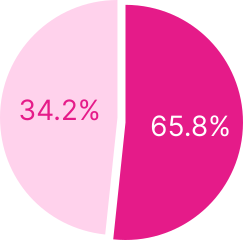
The WHO GLOBOCAN South-East Asia Report (2022) tracks the incidences of more than 3,000 new cases a day, spanning a total of 32 reported cancer types(1). Remarkably, 10 types of cancer, accounted for 62.14% of total new incidences and 65.8% of total mortality.
Only three among them (Breast, Lung, Colorectum) have established screening programs. The need for early-stage screening for more cancer types is crucial, given the rising incidence of cancers. Early detection can significantly improve survival rates and save lives.
(1) WHO - GLOBOCAN 2022. South-Eastern Asia
The need for early detection
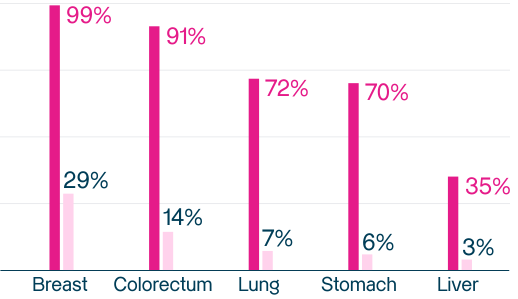
5-year survival rate percentage**
Early stage
Late stage
Early detection is key in the fight against cancer. It not only increases the chances of successful treatment but also significantly improves the quality of life for patients.
Common cancer types like breast or colorectum have >90% survival rate if detected early(2). However, more than 70% of cancers in low-income and middle-income Asian countries are diagnosed in late stage (3).
Main reasons for late detection:
- People with no obvious signs of cancer do not go for early cancer screening.
- Only few cancers types have recommended screening.
- Cancer symptoms mostly occur at late stage.
Late-stage diagnosis leads to(4):
- 5x higher mortality rate within 12 months.
- 50% higher chance of financial catastrophe.
(2) Statistics adapted from the American Cancer Society's (ACS) publication, Cancer Facts & Figures 2022 and Cancer Facts & Figures 2021; the ACS website; and the International Agency for Cancer Research website.
(3) Sankaranarayanan, R., Ramadas, K., Qiao, Y., 2014. Managing the changing burden of cancer in Asia. BMC Med 12, 3.
(4) ACTION (Asean CosTs in Oncology) STUDY, Singapore 2020.
03
What should we do to improve early detection?
Understand what causes cancer
Hereditary & Familial
25-30%(1)
attributed to
all cancers

- Inherited from familial gene
- Mutations in a person genome from birth
- All cells in the body have these mutations
- May be passed to future generations
- Screen for hereditary cancer risks: common genes associated with specific types of cancer.
Occurred mutations
70%(1)
attributed to
all cancers

- Caused by age, environment & lifestyle habits
- Mutations acquired over time
- New mutations are present at the tumor only
- Will not be passed to future generations
- Screen for tumor presence at early stages by annual screening checkup or using ctDNA multi-cancer early detection test.
(1) Garber J.E., Offit K. Hereditary Cancer Predisposition Syndromes. J. Clin. Oncol. 2005;23:276-292
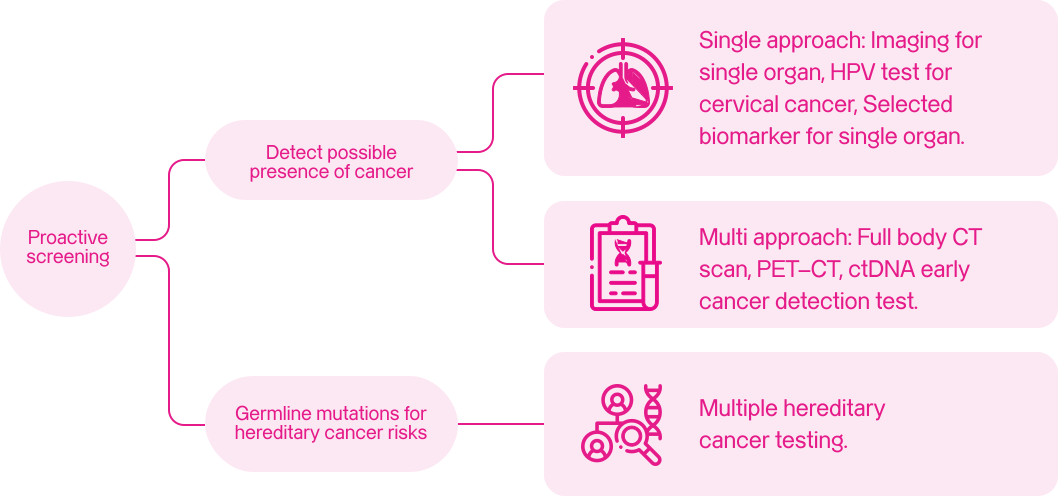
Awareness of screening methods
04
What screening options are available for me and my family?
Screening Availability
Once in a lifetime
Hereditary cancer risks test by informed choice. (Related genes that recommended by American Cancer Society or National Comprehensive Cancer Network).

Routine cancer screening
Some organs currently have screening programs available for each type. Talk to your primary care doctor for advice.
Complementary Screening
Annual ctDNA multi-cancer screening for more cancers that do not have screen program yet. Discuss with your primary care doctor to learn more about the test.
Screening programs and ctDNA screening
Recommended programs:(1)
- Breast cancer
Annual mammography for women above 40 years old. - Colorectal cancer
Start regular Stool-based test or Colonoscopy at age 45. - Lung cancer
Annual low-dose CT scan people age 50-80 who smoke or used to smoke. - Cervical cancer
Cervical cytology, HPV/PAP test every 03 or 05 years for people between the age of 25-65. - Prostate cancer
Prostate-specific antigen (PSA)-based testing starting at age 50 for men.
Annual mammography for women above 40 years old.
Start regular Stool-based test or Colonoscopy at age 45.
Annual low-dose CT scan people age 50-80 who smoke or used to smoke.
Cervical cytology, HPV/PAP test every 03 or 05 years for people between the age of 25-65.
Prostate-specific antigen (PSA)-based testing starting at age 50 for men.
Breakthrough SPOT-MAS next-generation ctDNA screening test:
Spot for early cancerous signal of:

Breast

Lung

Colorectum

Liver-Biliary tract

Stomach

Ovary

Pancreas

Esophagus

Endometrium

Head & Neck
● 7/10 currently have no standard-of-care screening program available.
(*) 10 Cancer Types Including Multi-omics dataset from 75 subtypes.
(1) American Cancer Society

Screening methods complementary to standard-of-care programs are available as informed choices. Talk to your healthcare provider about the pros and cons of testing to make decision.
05
Who should consider starting ctDNA screening?

Adults aged less than 40 years but have high risks

Adults aged 40 years & older
06
Why SPOT-MAS and what do results mean?
Strong clinical validation:
SPOT-MAS performance is validated in a research involves 9.024 participants, showing proven accuracy in cancer signal detection and tumor location prediction. (1)
Testing Laboratory:
The blood specimen is processed and tested at Gene Solutions Genomics Pte Ltd, a MOH-licensed clinical laboratory in Singapore. Results will be delivered to your doctor.
International Awards:
Gene Solutions' award winning ctDNA technology to screen for multi-cancer has been featured in: - American Society of Clinical Oncology (ASCO) Breakthrough 2023, 2024
- European Society for Medical Oncology (ESMO) Asia 2023, 2024
- >16 peer-reviewed international biomedical journal articles, including eLife Science, Nature publications, etc
(1) Nguyen, et al. "Analytical and clinical validation of a ctDNA based assay for multi-cancer early detection" (2023). doi:10.1101/2023.12.22.23300420
What do SPOT-MAS results mean?

Negative:
No ctDNA signal detected
ctDNA was not detected at the time SPOT-MAS test is conducted. This test provides a snapshot of the blood at the time of collection and does not predict for future cancer risks.

Next step
Continue with the SPOT-MAS test annually or other screens as recommended by your doctor. Do not ignore cancer signs or symptoms if they occur, as this could lead to a delayed diagnosis.

Positive:
ctDNA signal detected
ctDNA signal associated with tumor cells was detected in the blood. The result may include 1-2 predictions of the origins of tumor in the body where the cancer may be found.
Next step
As the SPOT-MAS test is a screening test, a confirmatory imaging test is required to confirm if cancer is truly present. Your doctor will advise you on the required following tests.

Patient Support Programs
For patients with a positive test result, partial reimbursement for following up diagnostic tests are available in some countries. Discuss with your doctor or contact us to learn more.
Testing process

Request the test through your primary care doctor. A prescription and 10ml blood collection are required.

Your extracted DNA from the plasma will be sequenced by Next-generation ctDNA technology to analyze multi-feature of DNA.

Receive your ctDNA signal analysis results after 12 working days from the time sample is received at Gene Solutions laboratories.

SPOT-MAS Portfolio
Explore More Cancer Screening Options with SPOT-MAS:
| Test | Scope | AI Technology |
|---|---|---|
Multiple features of 10 cancer types:
| Multi AI machine learning and deep learning models | |
| Multiple lung-specific features | Cell-free Multiomic ATLAS | |
SPOT-MAS CRC | Multiple colorectum-specific features |
(*) 10 Cancer Types Including Multi-omics dataset from 75 subtypes.
(*) Multi-cancer early detection test to complete clinical validation in Asia on