
Cost & Insurance Coverage for MCED Tests in Singapore
This article is for educational purposes only. It does not provide specific pricing, promotions, or purchasing recommendations. Instead, it explains the general cost structure of ctDNA-based MCED tests and current insurance coverage considerations, including why reimbursement remains limited at this stage.
In the context of this article, SPOT-MAS (developed by Gene Solutions) is referenced solely as an illustrative example of a blood-based multi-cancer early detection approach. No comparison, endorsement, or purchasing recommendation is intended.

Understanding the value behind the cost
Before looking at the actual cost & insurance coverage, it is important to understand what the Multi-Cancer Early Detection (MCED) test is, how much, and which factors may influence its pricing. The following sections provide both a clear explanation of the test and a closer look at the technologies behind it.
What is the Multi-Cancer Early Detection test?
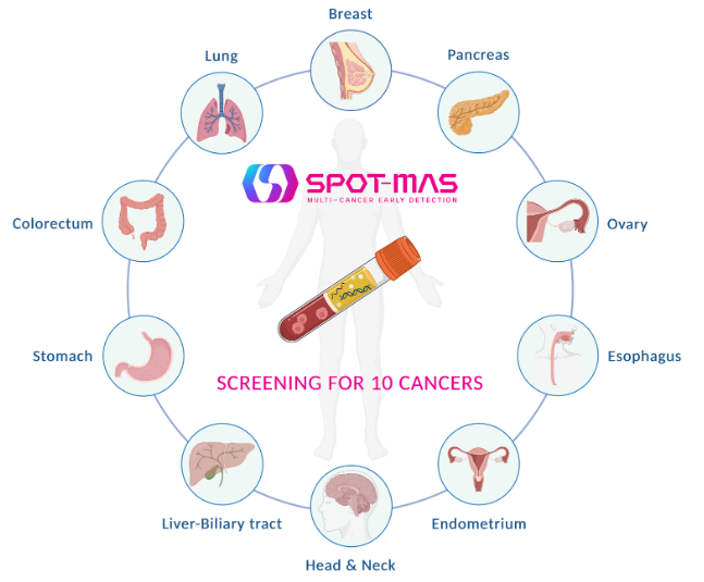
The Multi-Cancer Early Detection (MCED) test is is a non-invasive blood-based screening method that analyzes circulating tumor DNA (ctDNA) to detect multiple cancers early. Using a multi-omics approach, it integrates three scientific pillars: genetics, epigenetics, and fragmentomics, providing a broad view of tumor-related change.
SPOT-MAS, developed by Gene Solutions, is Asia’s first clinically validated MCED test. In the K-DETEK trial with 9,024 participants, it showed strong reliability and is designed to screen for up to 10 cancer types, including common and aggressive cancers. Combining multi-omics sequencing with stacking ensemble machine learning model, SPOT-MAS delivers an affordable, non-invasive option for early cancer detection in Singapore.
What is MCED test?
Cost of the MCED test in Singapore
In Singapore, the cost of a multi-cancer early detection (MCED) blood test varies depending on the technology platform, clinical validation status, and service model of the provider. Patients should note that pricing structures may differ across providers. It is therefore recommended to request an itemised and up-to-date quotation directly from the clinic prior to testing.
Factors that influence costs
When it comes to MCED testing, the overall cost can vary substantially across providers in Singapore. Rather than a fixed price, MCED testing may be influenced by multiple clinical, technological, and service-related factors.
Below are the key factors that influence the MCED test cost Singapore:
- Provider & technology platform: Different laboratories integrate advanced multi-omics methods (genetics, epigenetics, fragmentomics). The complexity and validation of these technologies contribute to higher baseline test prices.
- Consultation fees: Pre- and post-test consultations may be billed separately. Reports from major Singapore providers can show rising consultation charges, making them a significant part of the overall bill.
- GST and pricing structure: IRAS requires GST-inclusive final prices, but the exact inclusions vary by clinic. This inconsistency creates variation in total payable amounts.
- Clinic policies and promotions: Screening packages differ widely. Some private providers charge several thousand dollars, reflecting large variance tied to provider-specific policies.
- Follow-up diagnostics: If a positive screen occurs, further tests may add thousands of dollars in out-of-pocket expenses, significantly increasing total cost.
- Insurance and subsidies: Current subsidies may apply only to national screening programs. Some MCED blood tests may fall outside these schemes, meaning patients usually pay out-of-pocket.
Does insurance cover MCED tests?
No. In Singapore, multi-cancer early detection (MCED) blood tests are not covered by national insurance schemes.
Although insurance does not yet support MCED tests, investing in early detection can improve outcomes and reduce the need for intensive treatment when disease is found earlier [1]. Early-stage cancer detection is associated with substantially higher 5-year survival rates across multiple cancer types, reflecting a greater likelihood of localized, potentially curative treatment compared with late-stage diagnosis [2, 3, 4].
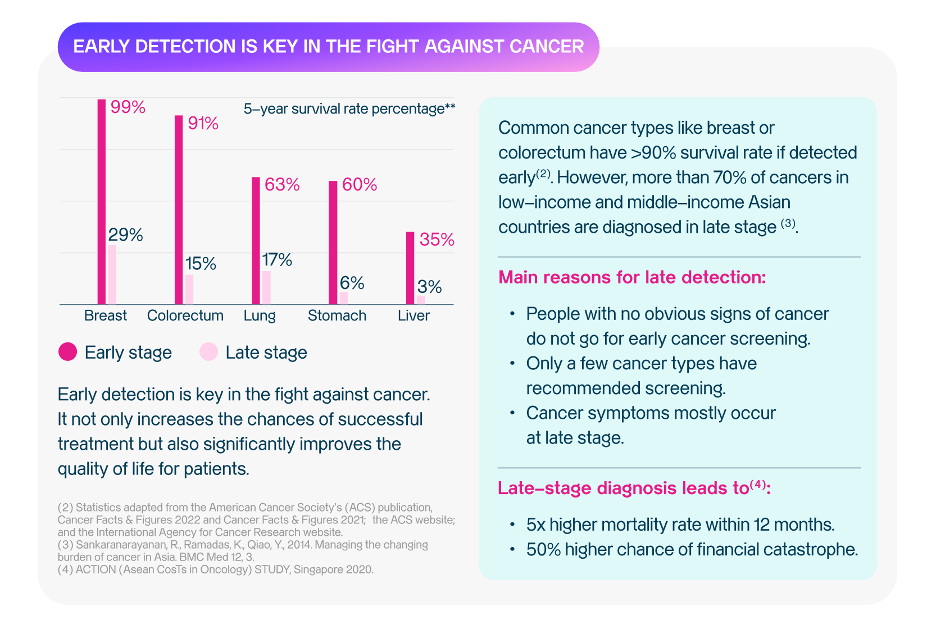
MCED test is associated with substantially higher 5-year survival rates across multiple cancer types
Why aren’t MCED tests covered by insurance?
Insurance companies are often cautious when deciding which new medical technologies to include in their plans, and cancer screening cost Singapore is no exception. While these blood-based screenings hold great promise, the cost & insurance coverage remain a concern because insurers have not yet recognized them as part of standard care. Below are the main reasons behind this limited coverage.
The technology can be still relatively new
MCED tests analyze blood for cancer signals using genetic, epigenetic, and fragmentomic features, often combined with machine-learning and AI to classify signals. While early studies are promising, evidence on long-term accuracy, population-wide benefit, and cost-effectiveness remains limited, and large-scale trials can be still ongoing. Because coverage decisions in Singapore may rely on health technology assessment (HTA), which evaluates effectiveness, safety, and cost-effectiveness, insurers remain cautious and often delay coverage until stronger evidence is available.
The need for additional diagnostic tests
MCED serves as a screening tool rather than a definitive diagnosis. A positive result may need to be followed by confirmatory procedures. These follow-up tests can increase overall healthcare costs and may expose patients to unnecessary risks if false positives occur. Singapore’s official screening framework also highlights that screening decisions must balance benefits against harms and consider cost-effectiveness, which helps explain why insurers are reluctant to cover MCED at this stage.
Accessing MCED testing in Singapore
MCED testing in Singapore is currently offered through a limited number of healthcare pathways. Access is typically facilitated through physician-guided screening in private healthcare settings, where testing decisions are made based on individual risk profiles, clinical context, and patient preference.
Since patients often consider both cost and insurance coverage when exploring screening options, understanding how MCED testing is accessed — rather than focusing on specific providers — is particularly important. Service models may vary across healthcare settings, including differences in clinical consultation, test administration, result interpretation, and follow-up care.
Gene Solutions
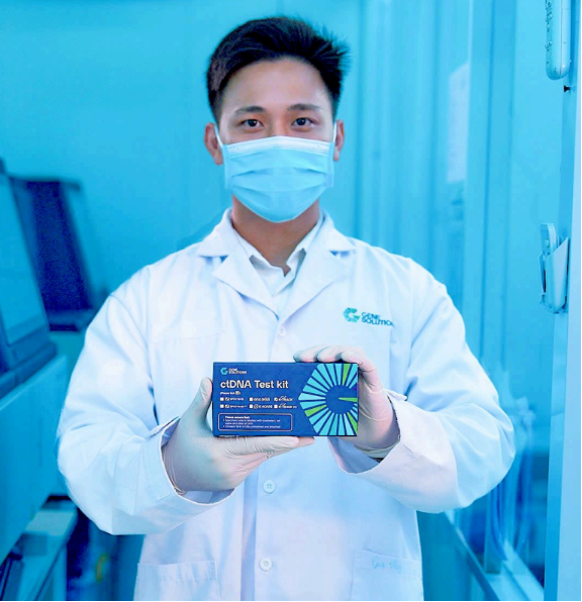
Gene Solutions is recognised as an early contributor to precision oncology in the region, having introduced the SPOT-MAS multi-cancer early detection test to Singapore. This is the first clinically validated MCED platform in Asia. By integrating multi-omics sequencing of ctDNA across three scientific pillars, together with advanced AI algorithms, Gene Solutions provides highly reliable results. These methods have been validated in large scale clinical studies, positioning the company as a trusted provider for early cancer screening.
Another strength of Gene Solutions lies in its ability to balance affordability and quality. The SPOT-MAS test is designed to be cost-effective compared to many international options, while still adhering to strict CAP-accredited laboratory standards. This ensures that patients in Singapore can access world-class technology without facing prohibitive costs, an advantage that sets Gene Solutions apart from other providers.
Address: Gene Solutions Genomics Pte Ltd, 5 Tai Seng Ave, #02-54, Tai Seng Exchange, Singapore 536671.
Gene Solutions
Why should healthcare professionals consider MCED testing?
MCED tests are being evaluated as an additional tool in preventive healthcare, intended to complement rather than replace traditional cancer screening methods. Choosing this test can provide peace of mind, actionable insights, and potentially life-saving opportunities for timely treatment. Key reasons to consider the MCED test include:
- Early detection: MCED aims to find cancers before symptoms appear, and earlier detection is linked to better outcomes in preventive screening programs [1].
- Non-invasive procedure: It is a 10mL blood draw used for screening, and a positive result must be confirmed with diagnostic methods.
- Broad coverage: MCED tests are designed to screen for multiple cancer types in a single blood test.
- Improved outcomes: Detecting cancer earlier generally allows less aggressive treatment and better chances of success.
- Peace of mind: Singapore’s screening guidance highlights the importance of tailoring screening to risk factors such as age and family history.
- Advanced technology: Modern MCED integrates multi-omics sequencing of ctDNA across genetics, epigenetics, and fragmentomics, combined with machine-learning/AI for signal classification and tissue-of-origin estimation.
Frequently Asked Questions
Before deciding on an MCED test, many patients want to understand its cost & insurance coverage, purpose, and practical benefits. The following questions and answers provide clear guidance, helping you make a more informed choice about whether this screening is right for you.
Who should consider an MCED Test?
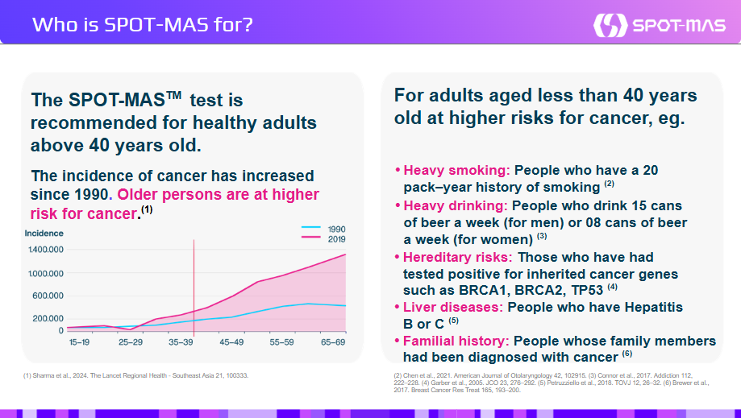
MCED tests are suitable for adults, especially those aged 40 and above, or anyone with a family history of cancer. They are also recommended for individuals who want a proactive health check beyond single-cancer screenings.
 Who should consider an MCED Test?
How much does the MCED test cost?
There is no single fixed price for MCED testing in Singapore. The cost depends on factors such as the test technology used, the number of cancer types covered, laboratory accreditation, and whether clinical consultation and follow-up support are included.
Because pricing and service scope vary between providers, individuals are advised to consult directly with their healthcare provider to obtain the most accurate and current cost information before proceeding with testing.
Are MCED tests used to treat cancer?
No. MCED tests are used only for screening. If a positive signal is found, diagnostic evaluation is required, followed by appropriate specialist treatment if cancer is confirmed.
Will health insurance pay for MCED tests?
Currently, MCED tests are generally not covered by insurance because the technology is still relatively new and has not yet been included in national screening guidelines. Patients should be prepared to cover the costs themselves unless special insurance arrangements apply.
Conclusion
In conclusion, the cost and insurance coverage for MCED tests in Singapore reflect both the opportunities and current challenges of this innovative screening method. Because fees can differ depending on the provider, test panel, and services included, patients are encouraged to contact their healthcare facility directly to receive the most accurate and up-to-date information. This ensures transparency and helps individuals make informed decisions about their screening options.
At present, MCED tests are generally not covered by insurance due to limited regulatory approval, the newness of the technology, and the need for confirmatory diagnostic procedures. Still, providers such as Gene Solutions are making these tests more accessible with clinically validated platforms and affordable options. For those considering proactive healthcare, exploring MCED testing with Gene Solutions can be a meaningful step toward early cancer detection and peace of mind.
Disclaimer:
This content is for educational purposes only and does not constitute medical advice. Multi-Cancer Early Detection (MCED) tests should be considered and ordered by licensed healthcare professionals. Availability and regulatory permissions vary by country.
Reference:
[1] Nguyen, L. H. D., et al. Prospective validation study: a non-invasive circulating tumor DNA-based assay for simultaneous early detection of multiple cancers in asymptomatic adults. BMC Medicine. 2025. https://bmcmedicine.biomedcentral.com/articles/10.1186/s12916-025-03929-y
[2] Statistics adapted from the American Cancer Society’s (ACS) publication, Cancer Facts & Figures 2022 and Cancer Facts & Figures 2021; the ACS website; and the International Agency for Cancer Research website.
[3] Sankaranarayanan, R., Ramadas, K., Qiao, Y. Managing the changing burden of cancer in Asia. BMC Med. 2014.
[4] ACTION (Asean CosTs in Oncology) STUDY, Singapore. 2020.